
The figures in this piece were taken on the morning of Wednesday 16 September 2026. Price and monthly series come from our own closing history; ETF flows come from Farside, with 14 September the last complete session; and listed treasury holdings come from our weekly snapshot, which freezes the aggregate every Monday.
The price, in four numbers
Bitcoin trades at $75,813.
That number on its own says very little, so here are the other three. August closed at 77,830, which puts the month 2.6% down. 2025 closed at 87,509, which puts the year 13.4% down. And twelve months ago, in September 2025, the price was 114,056 dollars, which puts the trailing year 33.5% down.
Then the fourth, the one quoted most and the one that explains least: the all-time highATHAll-Time High: the highest price an asset has ever reached.View term → of 126,080 dollars set on 6 October 2025 sits 39.9% above today's price.
All four are true at once and they describe different things. The month is about Tuesday's session. The year is about a market that has been correcting for nine months. The trailing year is about the cycle. And the distance to the high is about the expectations of whoever bought in October.
The ETFs have stopped buying
This is the change of the month.
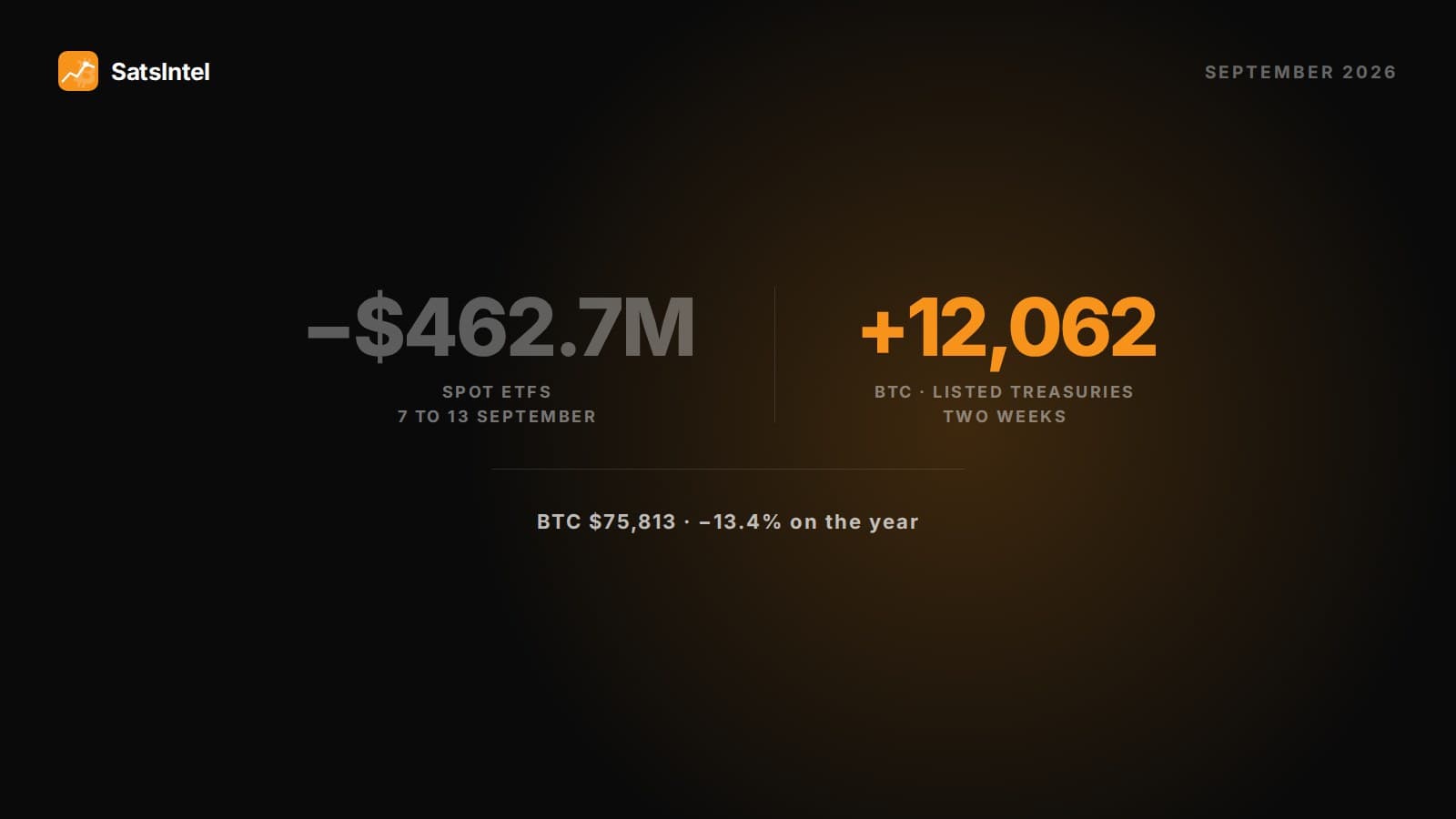
Spot ETFs arrived off three consecutive weeks of inflows: $1,881.6 million in the week of 17 August, 842.6 in the week of the 24th and 898.1 in the week of the 31st. The streak broke in the week of 7 to 13 September, with $462.7 million of outflows. In the following week, through Tuesday the 15th, they were another $128.8 million in the red.
The month to date through 14 September is still positive at $388 million. The problem is that all of August came to $3,328.8 million. At this pace September is heading for one ninth of August.
The fund-by-fund breakdown explains the rest. So far this month IBIT has taken in $567.4 million and almost everything else has lost money: GBTC 221.2, ARKB 155.9, FBTC 124.3, HODLHODLThe strategy of holding Bitcoin long term without selling, regardless of price.View term → 32.7. Strip out IBIT and the entire complex is in outflows.
That asymmetry is not a September story. Year to date, IBIT has gathered $2,045.8 million of inflows and GBTCGBTCGrayscale Bitcoin Trust: the first BTC investment vehicle for institutional investors in the US.View term → $2,572 million of outflows, with FBTC at negative 1,994.2 and ARKB at negative 470.7. One fund holds the vehicle up and the rest of the sector shares the bleeding. Between the twelve of them, spot ETFs now hold 1,269,951 bitcoin, and 796,698 of those, 62.7%, sit in IBIT.
The treasury companies have started buying again
And here is the other half of the story, running the other way.
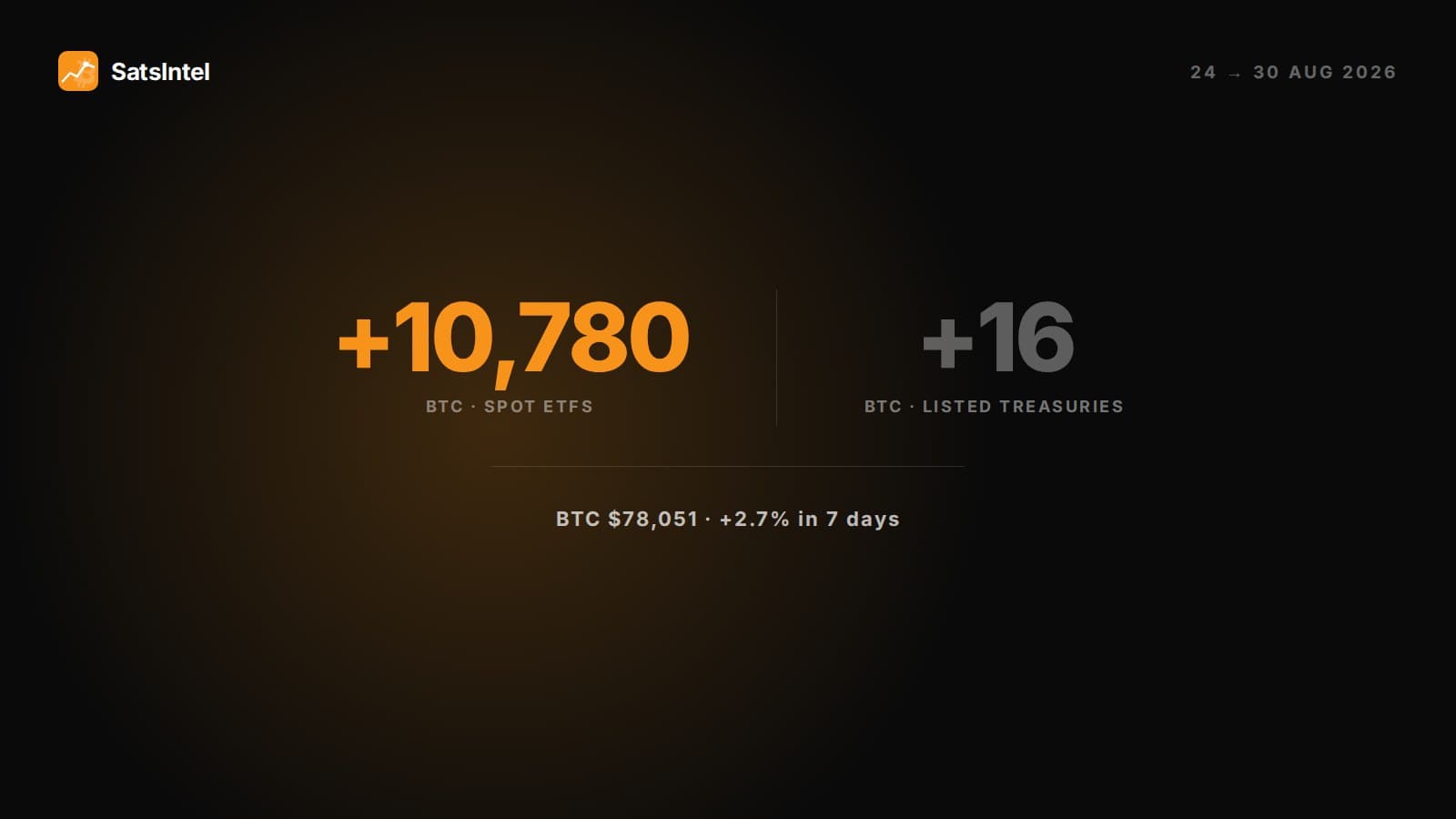
August was flat or worse for listed treasuries. In the week of 10 August they sold 1,638 bitcoin, in the week of the 17th another 1,690, in the week of the 24th they bought 16 and in the week of the 31st they moved nothing at all. Four weeks to leave the aggregate exactly where it started.
In September the aggregate went from 1,282,517 bitcoin to 1,293,205 in the 7 September snapshot, and to 1,294,580 in the one taken on the 14th. That is 12,062 bitcoin in two weeks, after a full month of standing still.
Part of it has a name. Strategy bought 4,603 bitcoin on 1 September, around 370 million dollars, taking it to 845,050. It was its first purchase in two months. On 14 September it did something different and just as revealing: it bought back 139 million dollars of its STRC preferred without buying a single bitcoin. When the preferred trades below par, buying it back returns more than accumulating, and the company ran that maths.
The rest of the move is spread across the other 179 companies in the aggregate, now 180 because a new one joined. Together, listed treasury companies hold 1,294,037 bitcoin, worth around 98,048 million dollars, roughly 6.2% of the twenty-one million that will ever exist.
The crossover
Put the two series side by side and the number of the month appears.
In August the ETFs bought and the treasuries stopped. In September the treasuries buy and the ETFs stop. It is the same operation with the roles swapped, and it is worth understanding why it happens, because the buyer is a different animal in each case.
An ETF flow is the sum of daily decisions by thousands of investors who can leave tomorrow with one click. It responds to headlines, to Tuesday's session, to noise. A treasury purchase is a board decision, funded by an issuance prepared over weeks, and it does not unwind because of a Senate vote. One of these two buyers has the door right beside them and the other has it a long way off.
Fast money leaving while slow money arrives says something about who is setting the price in this stretch. It also explains how bitcoin held by ETFs and treasuries adds up to around 2.56 million coins today, about 12.2% of everything that will ever exist, without the price reflecting that accumulation.
What happened on Tuesday
On 15 September the Senate killed the Clarity Act 49 votes to 50. The price went from around 79,530 dollars to close near 75,750, some 570 million in long positions were liquidated, and the next day spot ETFs recorded 450.33 million of outflows, the largest single session since 25 June. We covered it in full in the news piece.
What matters for this article is something else: the listed companies in the sector fell more than the asset. Coinbase between 6.7% and 8%, Circle around 8%. Bitcoin, 4%. When bad regulatory news lands, the market punishes the regulated intermediary first and the asset second, which is exactly what you would expect if the uncertainty being priced is about licences rather than about bitcoin.
What to watch over the coming weeks
Three things, and the price is none of them.
First, whether the ETF outflows become a trend or stay a two-week reaction. The control point is whether IBIT stops offsetting the rest, because so far it has done so every month of the year.
Second, whether the treasuries keep buying in October. Two good weeks after a flat month can be the start of something or can be one Strategy purchase with everyone else standing still. The next few Monday snapshots will settle it without argument.
Third, the cost of capital. While the mNAV of the large treasuries sits close to one, every new issuance buys less bitcoin per share issued. That number decides whether the second half of the year looks like August or like June, far more than any vote does.