

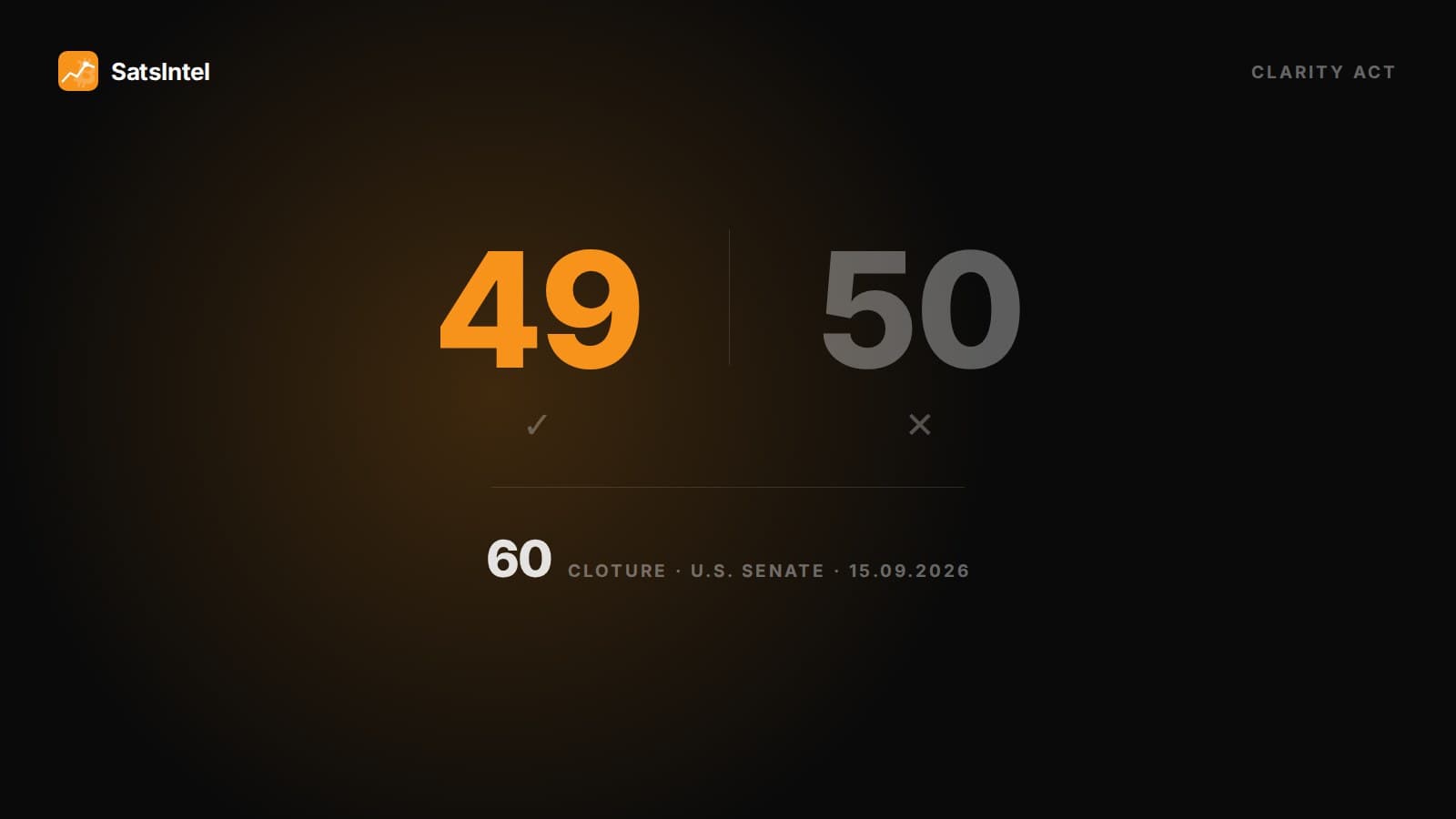
The United States Senate shot down the procedural vote that was meant to open debate on the Digital Asset Market Clarity Act on Tuesday September 15, the market structure bill the industry had been chasing for two years. The count was 49 in favour and 50 against, well short of the 60 a cloture motion requires in the Senate. It did not even gather a simple majority.
The bill had already cleared the House of Representatives. The Senate was the last step, and that is where it stopped.
How the vote broke down
All fifty Democrats voted no. Four Republicans joined them: Susan Collins, Josh Hawley, Jerry Moran and Thom Tillis. Democrat Chris Coons did not vote.
The part that stings most is elsewhere. Seven Democrats who had spent months at the negotiating table ended up voting no: Kirsten Gillibrand, Mark Warner, Cory Booker, Raphael Warnock, Ruben Gallego, Angela Alsobrooks and Catherine Cortez Masto. Negotiators had closed more than 600 pages of compromise text. They ran aground on the last few.
The clause that broke the deal
What never got agreed was the ethics package: the provisions restricting senior officials from holding financial interests in the industry they regulate.
Mark Warner put it this way: "failure to address this fundamental conflict of interest made it impossible for me to support moving forward". Senator Elissa Slotkin called the ethics package "simply too thin" and named the president, his children and Commerce Secretary Howard Lutnick. By the Republican account, Donald Trump accepted concessions on that front twice, the last of them over the weekend before the vote.
There was a second front. Democrats objected to the provisions allowing stablecoins to pay rewards resembling those of a bank deposit, and that was also part of why Josh Hawley voted no.
Cynthia Lummis, the lead Republican negotiator, appealed to the floor before the vote: "Do not let this day be the day we handed our future to someone else because we were too afraid to finish what we started. Let's vote yes." Afterwards she accused Democrats of never having been serious. Minority Leader Chuck Schumer returned the serve: "Republican leadership walked into the room, broke up the bipartisan discussion and said, 'No, we're done.'"
What the bill would have changed
The Clarity Act divided up work that two regulators currently fight over. It defined what counts as a security and what counts as a digital commodity, and gave the CFTC express authority over crypto spot markets, leaving the SEC the ground that belongs to it. For a company trying to operate in the United States, that boundary is the difference between knowing which door to knock on and litigating to find out.
SEC Chairman Paul Atkins had already flagged what now lies ahead: rules written by an agency without legislative backing are not durable. They last as long as the administration that signs them.
The market reaction
Bitcoin came into the session around $79,530 and ended the night near $75,750, between 3% and 4% lower over twenty-four hours. The CoinDesk 20 index fell 4.6%. XRP gave up 8.1% and Stellar 9.6%. Roughly $570 million in long positions were liquidated.
Listed companies in the sector took it worse than the asset. Coinbase fell between 6.7% and 8% depending on the close, Circle around 8%, Bullish 4.6%. The following day spot ETFs recorded $450.33 million of outflows, the largest single session since June 25.
Alice Liu, head of research at CoinMarketCap, set the context: bitcoin open interest had been falling around 3.5% over the week, and spot ETFs had already shed some $300 million across five sessions before the vote. The market had been shedding risk on its own.
How the industry took it
Brad Garlinghouse, chief executive of Ripple, was the bluntest: "This one stings. Our team gave everything we had to get the Clarity Act across the finish line."
Michael Saylor took the opposite angle and pointed out that Bitcoin has had legal and regulatory clarity in the United States for years, which holds for bitcoin and holds a good deal less for the rest of the market. That distinction explains why the asset fell less than the platform equities.
Alex Blume, of Two Prime, summed up the calendar: without the sixty votes, any near-term prospect of definitive crypto legislation is gone. Joshua Riezman, of GSR, pointed to where the game moves next: the regulators. And Frederik Gregaard, of the Cardano Foundation, looked across the Atlantic: in Europe, at least, builders know the rules of the game under MiCA.
What happens now
Three roads, none of them quick.
The first is rulemaking. The SEC and the CFTC will keep writing rules on their own, with the fragility Atkins described. The second is another run at the Senate, which leadership can reopen, although floor time before the November 3 midterms is scarce. The third is the lame duck session, between the election and the end of the term, with this Congress ending December 31 and the next seated January 1.
If November 3 hands Democrats control, the legislative priority on digital assets probably shifts from regulating to investigating.
What it means for a treasury company
For a company holding bitcoin on its balance sheet the direct impact is small and the indirect one is larger. Bitcoin as a digital commodity already had its slot, which is why Saylor could say what he said. What stays unresolved is everything around a treasury: who custodies and under which licence, what can be pledged and to whom, how an issuance backed by digital assets gets registered, and what happens when the regulator that signed the rule changes chair.
That uncertainty carries a price, and the price is paid in cost of capital. It shows up in listed treasury companies before it shows up in the asset, which is exactly what Tuesday's session demonstrated.