
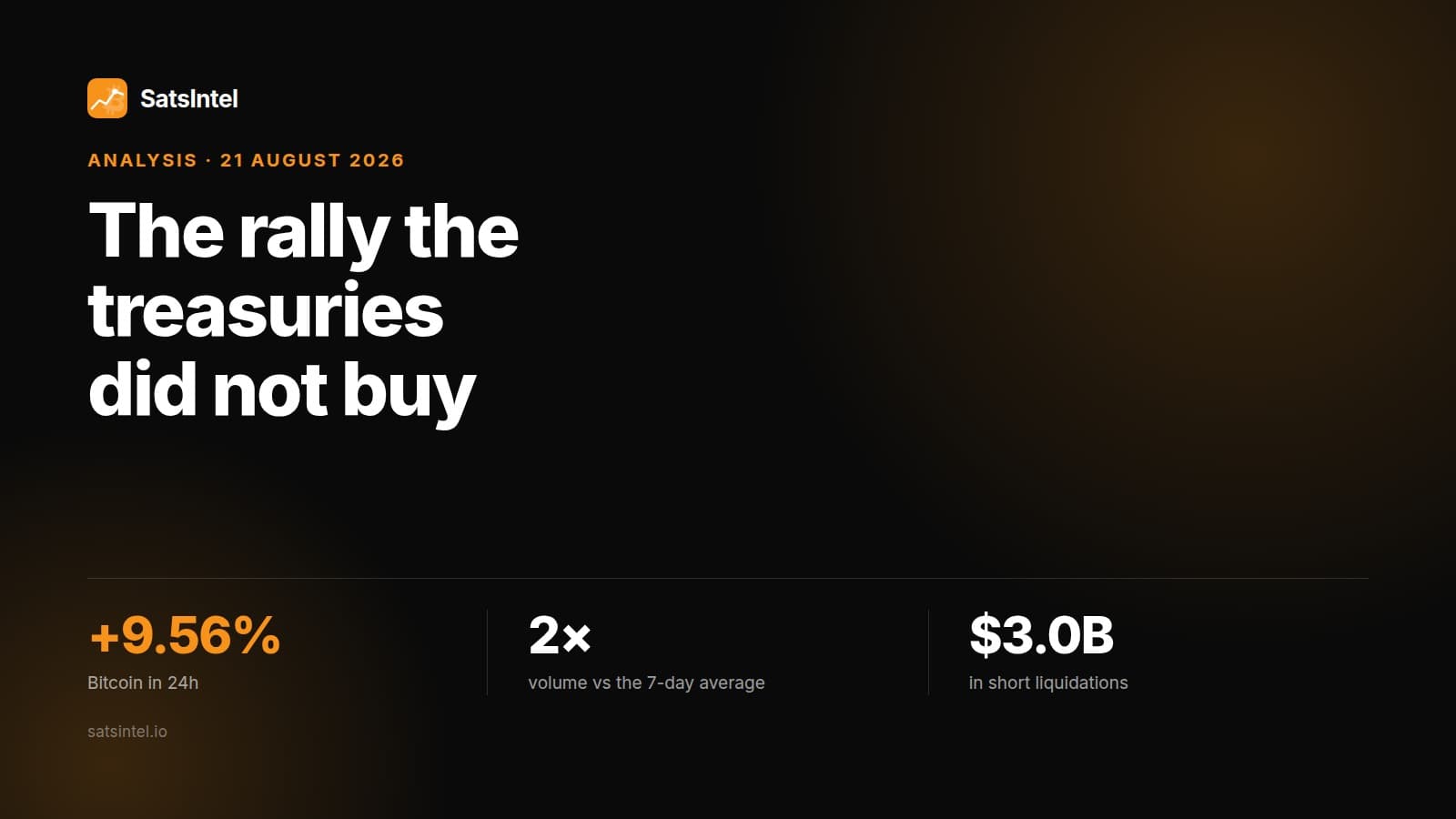
Bitcoin is trading at $76,310 this Friday 21 August at 9:50 in the morning, 9.56% above where it was twenty-four hours ago. On Monday the 14th it opened the week at $63,491. That is roughly twenty thousand dollars in five sessions, the strongest run since March.
The number is not the interesting part. Who bought is. And the answer, reading the data we publish every day, is uncomfortable: it was neither the corporate treasuries nor the spot ETFs. This rally was paid for, almost entirely, by whoever was short.
What happened, in numbers
Volume is the figure that describes the session best. Over the last twenty-four hours $63.7 billion in Bitcoin changed hands, against a $31.5 billion average across the previous seven days: 101.9% more, exactly double. Rallies on flat volume deserve suspicion; this one does not.
Bitcoin's market capitalisation rose to $1.53 trillion, up 10.04% in a day, on a circulating supply of 20,071,518 coins.
The sequence, day by day: on Wednesday the 19th Bitcoin gained close to 8% and closed at $69,749, its highest since early June. On Thursday the 20th it broke $72,000. Overnight, with Asia open, it cleared $75,000.
One boundary is worth setting. The all-time highATHAll-Time High: the highest price an asset has ever reached.View term → is still the $126,198 of October 2025. For all the violence of the move, Bitcoin remains some 40% below its ceiling.
The shorts: who paid for the rally
Between 19 and 20 August roughly $3 billion in short positions were liquidated. Longs, over the same window, accounted for barely $264 million. The ratio is better than eleven to one.
In a single sixty-minute stretch, more than $1 billion in shorts was wiped out. By venue, Binance took around $518 million, Hyperliquid $513 million and Bybit $303 million.
The contrast with the rest of the year explains why this caught so many people out. June brought two liquidation events of comparable size — around $1.8 billion and $1.76 billion — and in both it was the longs that blew up. The same machinery, running the other way.
One detail helps convey the mood: on 19 August, with Bitcoin up 8%, the Fear & Greed index read 46, in fear territory. And the Coinbase premium index — which measures whether the US buyer is paying up relative to everyone else — had been negative for ninety consecutive sessions through 16 August. Nobody was positioned for this.
The ETFs arrived late
This is where the easy narrative breaks. According to the flow data we publish daily, the twelve US spot Bitcoin ETFs recorded:
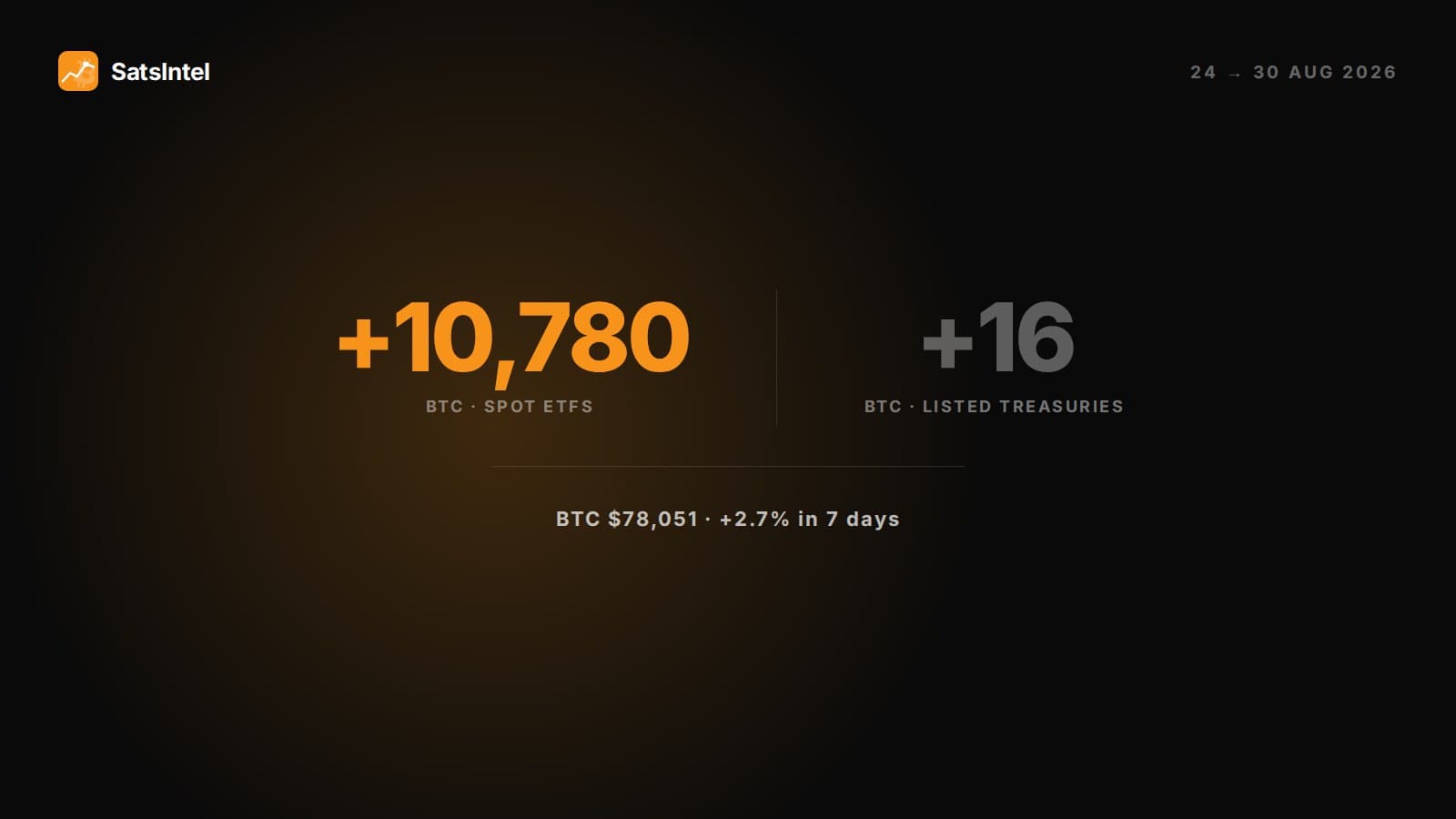
$497.5 million in net inflows on Wednesday 19 August, the best day of the month by a distance. IBIT took $284.7 million of it.
Just $38.6 million on Thursday the 20th — the day Bitcoin broke $72,000. One tenth as much.
Put differently: institutional money came in before the strong leg, not during it. On the day of the move, the ETFs were all but idle.
Lift your eyes from the short term and the picture is less triumphant still. August has brought $1.42 billion in net inflows, true. But 2026 to date is still negative: −$4.52 billion. Since launch they have taken in $50.26 billion, part of which has walked back out this year. The ETFs are not buying the rally: they are recovering some of what they let go.
Nor did the treasuries
This is our home turf, so precision matters.
Strategy did not buy a single bitcoin between 10 and 16 August, the week before the breakout. It holds 847,665 BTC, around 65.5% of all corporate Bitcoin in the world. In that same week it sold 3,458,866 of its own shares for roughly $333.7 million and lifted its dollar reserve to $4.8 billion, some $150 million more. It raised cash and left it as cash.
That is not a whim. Strategy operates under its Digital Credit Capital Framework, which puts preferred dividends, debt interest and securities repurchases ahead of further accumulation. We saw it earlier this month, when it sold bitcoin to cover coupons.
Metaplanet, the third largest holder in the world, did not buy either: on 18 August it announced it is putting 2,100 BTC and $2.5 million in cash into taking 95.7% of Super League, around $134.6 million in aggregate, to launch Superplanet as its US treasury platform. It is moving bitcoin, not adding it.
The global aggregate does keep growing — treasuries hold 1,293,479 BTC, 6.16% of circulating supply, with roughly 277,000 BTC added net over the last six months — but that is a trailing figure. In the specific week of the rally, the two largest were on the sidelines.
SATA back at par: what fixed income is saying
The most informative move of the week is not in Bitcoin's price but in an instrument almost nobody watches: the preferreds tied to treasury companies.
SATA, Strive's variable-rate Series A preferred, trades at $99.91 against a $100 stated amount. That is its closest approach to par since mid-June. It pays 13% a year in daily dividends of $0.0516 per share every business day, and Strive has confirmed that 13.00% rate for September as well.
Now set that against Strategy's five preferreds quoted the same day:
STRF at $97.65 on a 10% coupon — a 10.2% effective yield. STRC at $95.25 on a 12% coupon — 12.6% effective. STRD at $70.80 on a 10% coupon — 14.1% effective. STRK at $69.71 on an 8% coupon — 11.5% effective. And STRE, the euro issue, with no visible retail price because it trades on Luxembourg's Euro MTF.
The easy read would be "the variable-rate ones hold par and the fixed-coupon ones do not". It is wrong, and we took it apart when we compared STRC with SATA: STRC is variable-rate too and sits almost five points below its stated amount — and that is despite months of Strategy buying it back, some $25 million in late July at an average of $86.52, then tranches of roughly $81 million, $109 million and $132 million into mid-August. Close to $347 million defending a price that still has not returned.
If the mechanism is the same and the outcome is not, what separates them is not the design of the instrument: it is how the market prices the issuer's risk. Strive has not had to sell bitcoin to pay its preferred holders. Strategy has. The fixed-income market is charging for that, and it charges more coldly than the equity market does.
One detail seals the argument: STRD offers 14.1% effective today, more than SATA's 13%, and still trades 29% below its stated amount. When an investor demands more yield for the same kind of paper, they are not buying yield. They are asking to be paid for risk.
Why it rose: three catalysts and a mechanism
Ordered by what the data can actually support:
1. The US Treasury. Secretary Bessent doubled the size of long-dated bond buyback operations, from $2 billion to at least $4 billion per operation across the 10-to-30-year sectors, effective 9 September. The thirty-year yield fell from 5.337% to 5.189%. Less yield on the risk-free asset means a lower opportunity cost for holding an asset that yields nothing — which is precisely what Bitcoin is.
2. The SEC. On 18 August it published its Regulation Crypto Assets proposal, with a $5 million exemption for early-stage projects over four years, another of $75 million per twelve-month period, and a safe harbour letting an asset stop being treated as a security once it is sufficiently decentralised. It is the first time the regulator has sketched an orderly exit from limbo.
3. Washington. On 19 August the White House convened the chief executives of Coinbase, Ripple, Robinhood, Nasdaq and ICE. Trump asked Congress to pass "a fair version" of the CLARITY Act.
And the mechanism. On that bed of news, price broke $69,000 — a ceiling that had capped Bitcoin through weeks of a $64,000-to-$69,000 range — and from there the move fed itself. Every stop on a short position was a market buy order pushing price into the next stop. The $3 billion in liquidations is not a consequence of the rally: for a few hours, it was the rally.
What to watch now
A short squeeze resolves a positioning imbalance. It does not create new demand. Once there are no more shorts to liquidate, price needs real buyers to hold. Three things will tell you whether they exist:
ETF flows over the coming days. If Thursday the 20th was an accident and the $300-500 million days come back, there is structural demand behind this. If they stay in the tens of millions, there is not. You can follow them on our flows page, updated daily.
The first corporate purchase after the rally. One treasury buying at $76,000 says far more than ten buying at $64,000. And if Strategy keeps raising capital without buying, that is itself a signal about how the largest holder of bitcoin in the world sees the price.
The preferreds. If SATA holds par and STRC starts recovering without needing buybacks, the market is telling you balance-sheet stress across the treasuries is easing. If STRC slips again, it is not.
None of this is a recommendation. It is what the numbers say on a Friday morning, and next week's numbers may say something else.