
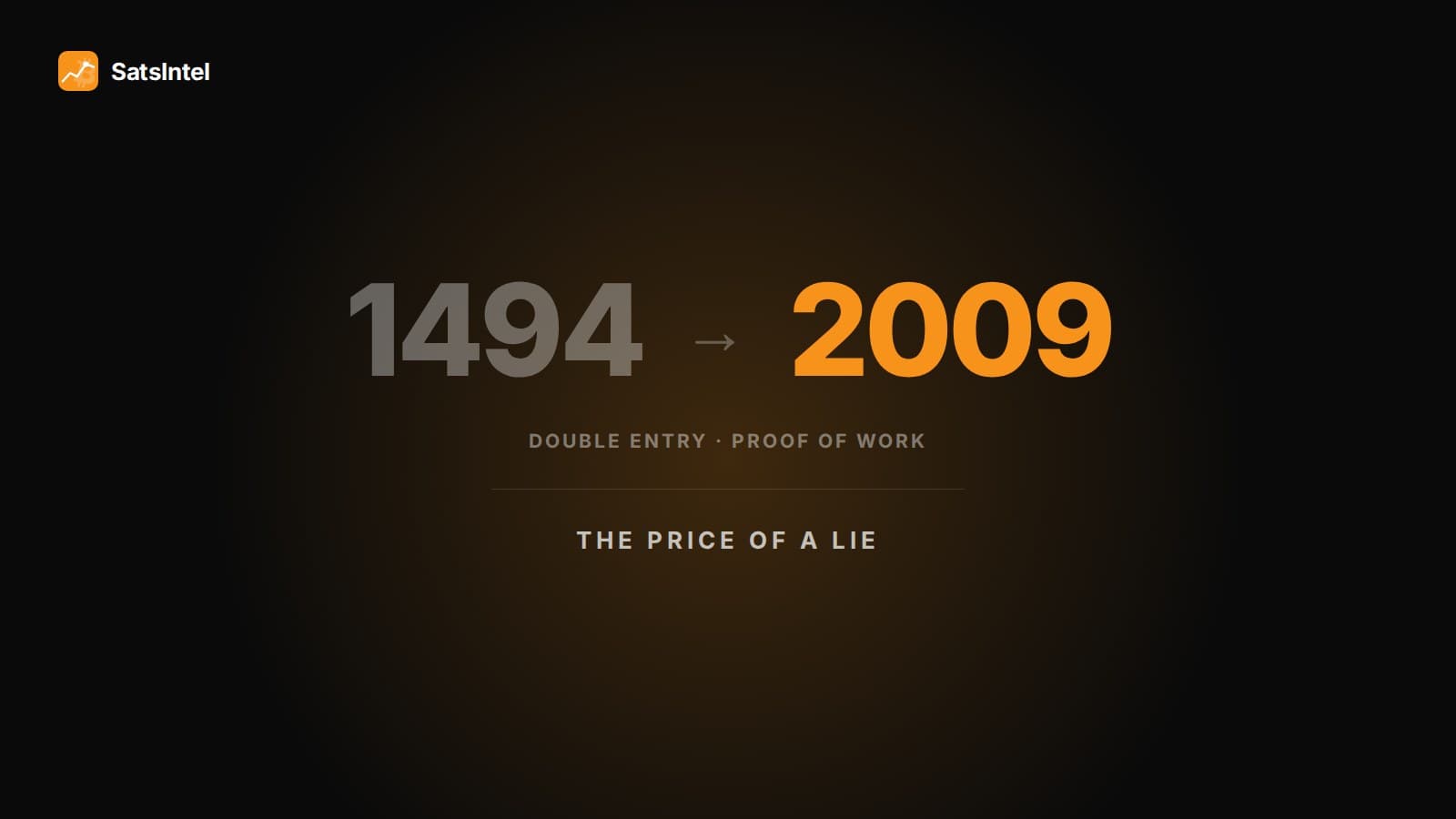
In 1494 a Franciscan friar named Luca Pacioli published a mathematics treatise in Venice that included, almost in passing, thirty-six chapters on how Venetian merchants kept their books. Those chapters described double-entry bookkeeping: every entry is recorded twice, once as a debit and once as a credit, and the two columns have to balance.
For five centuries we have told this as a story about accounting technology. I think it is something else. Pacioli did not describe a more convenient way to write things down. He described a way to make lying expensive.
With a single entry, falsifying an account costs one stroke of a pen. With double entry it costs two strokes that agree with each other, and where many accounts interlock it costs redoing half a ledger to keep it balanced. The invention was not the column. It was the price.
Every accounting system is a machine for making lies expensive
Once you see the pattern, it shows up everywhere.
The notary makes denying a signature expensive. The land registry makes claiming a house expensive. The eyewitness makes changing your story expensive. The external audit makes dressing up a balance sheet expensive, because it forces you to persuade a third party who is staking their signature on it.
None of these mechanisms makes lying impossible. All of them make lying costly, and then trust that the price is high enough that almost nobody finds it worth paying. It is an economic calculation dressed as a moral principle.
And the price can be negotiated
The trouble with that calculation is that somebody sets the price, and somebody can always be brought to the table to discuss it.
In 2001 Arthur Andersen was one of the five largest audit firms in the world and it kept Enron's books. It charged for auditing them and charged considerably more for advising the same company on other things. When the moment came to decide whether to sign, the cost of lying for Andersen was losing an eighty-nine-year reputation. The cost of not lying was losing a client paying tens of millions a year.
It signed. And eighty-five thousand people lost their jobs when the firm came apart.
The lesson usually drawn is that more regulation was needed, and Sarbanes-Oxley came out of it. The more useful lesson seems to me to be different: no system made of people can guarantee that the cost of lying stays high, because people are precisely the part of the system that entertains negotiations.
The first time the price stopped being a human decision
What proof of workProof of WorkBitcoin's consensus mechanism: miners compete to solve complex mathematical problems.View term → does is take that price off the negotiating table.
Rewriting a block of the chain means redoing that block's work and the work of every block that came after it, faster than the rest of the network, which has not paused in the meantime. The cost of that operation is measured in joules and in hardware. Not in reputation, not in years of standing, not in the loyalty of an audit partner.
A joule does not take bribes. It has no family to support, no mortgage to pay and no client representing 30% of its office's billings. It is the first time in the history of accounting that the cost of falsifying the record is out of reach of whoever would want to falsify it.
That is why proof of work is not an implementation detail that will one day be swapped for something more efficient. It is the whole mechanism. Take the cost away from Bitcoin and you take away exactly the thing that makes it different from a well-run database.
The energy objection, read backwards
The most repeated criticism of Bitcoin says it burns too much electricity for the transactions it processes. The comparison is usually with Visa: so many watts per payment against so many others.
That comparison assumes the electricity buys transactions. It buys something else. It buys the fact that transactions already made are ruinously expensive to undo.
Visa processes payments beautifully and can reverse any of them with a phone call, because there is a company behind it making the decision. That is a virtue in a payments system and the precise opposite of what a property register needs if it has to outlive whoever administers it.
A ledger nobody can afford to falsify costs exactly what falsifying it would cost. That is the price, and it is paid up front and every day. Asking whether the same thing can be had for less is asking whether a safe can be equally secure with thinner walls.
What this changes for a company
Here is where it stops being philosophy and starts having consequences on a balance sheet.
Almost every line on a company's asset side exists because somebody signs that it exists. The bank balance exists because the bank certifies it. Inventory exists because somebody counted it and an auditor checked a sample. Goodwill exists because a model says it is worth that.
The bitcoin held by a listed treasury company is the first line any outsider can verify on their own. The company publishes an address, and the balance of that address sits on the chain, where a shareholder, a journalist or a competitor can read it without asking permission and without waiting for the annual report.
That inverts a relationship that has run the same way for five centuries. Trusting the auditor stops being necessary for the existence step. Proof of reserves replaces a signature with a check.
Where the limit is, said honestly
It pays not to overstate the conclusion, because the part the chain does not solve matters.
The chain proves that certain coins exist at a certain address. It does not prove who controls the key that moves them. It does not prove those coins are unencumbered, that they have not been pledged twice, or that the company does not owe more than it shows.
All of that still needs documented custody, internal controls and a digital asset audit done by someone who knows what they are looking at. The auditor does not disappear. The role changes: it no longer certifies that the asset is there, because that is visible, it certifies who can move it and under what conditions.
It is a partial improvement, and partial improvements are the only kind there are.
What you pay for when you pay for truth
Every organised society spends part of its wealth making certain things verifiably true. It pays for registries, notaries, cadastres, archives, courts, professional bodies and audit firms. None of that produces goods. All of it produces certainty, and certainty is the condition for producing everything else.
That spending has never bothered us because it arrives spread across fees, retainers and taxes, and because it never appears on a single invoice with a number at the bottom. Bitcoin did something uncomfortable: it put that cost on one line, measured in watts, in plain view.
The discomfort does not come from the cost being new. It comes from the cost being legible for the first time.
And a thing you can read is a thing you can audit, which is exactly what Pacioli's book was about.