
Every so often someone asks me the same question, almost always in the same tone: why am I so optimistic about Bitcoin.
My answer tends to disappoint, because it starts by talking about artificial intelligence and takes a while to get to Bitcoin.
What is getting cheaper is not intelligence. It is the second copy
There is a clean way to measure what is happening, and it consists of no longer asking how much the technology has improved and asking instead what it costs today to buy a level of quality we already knew yesterday. You fix the bar and you check the market price every few months.
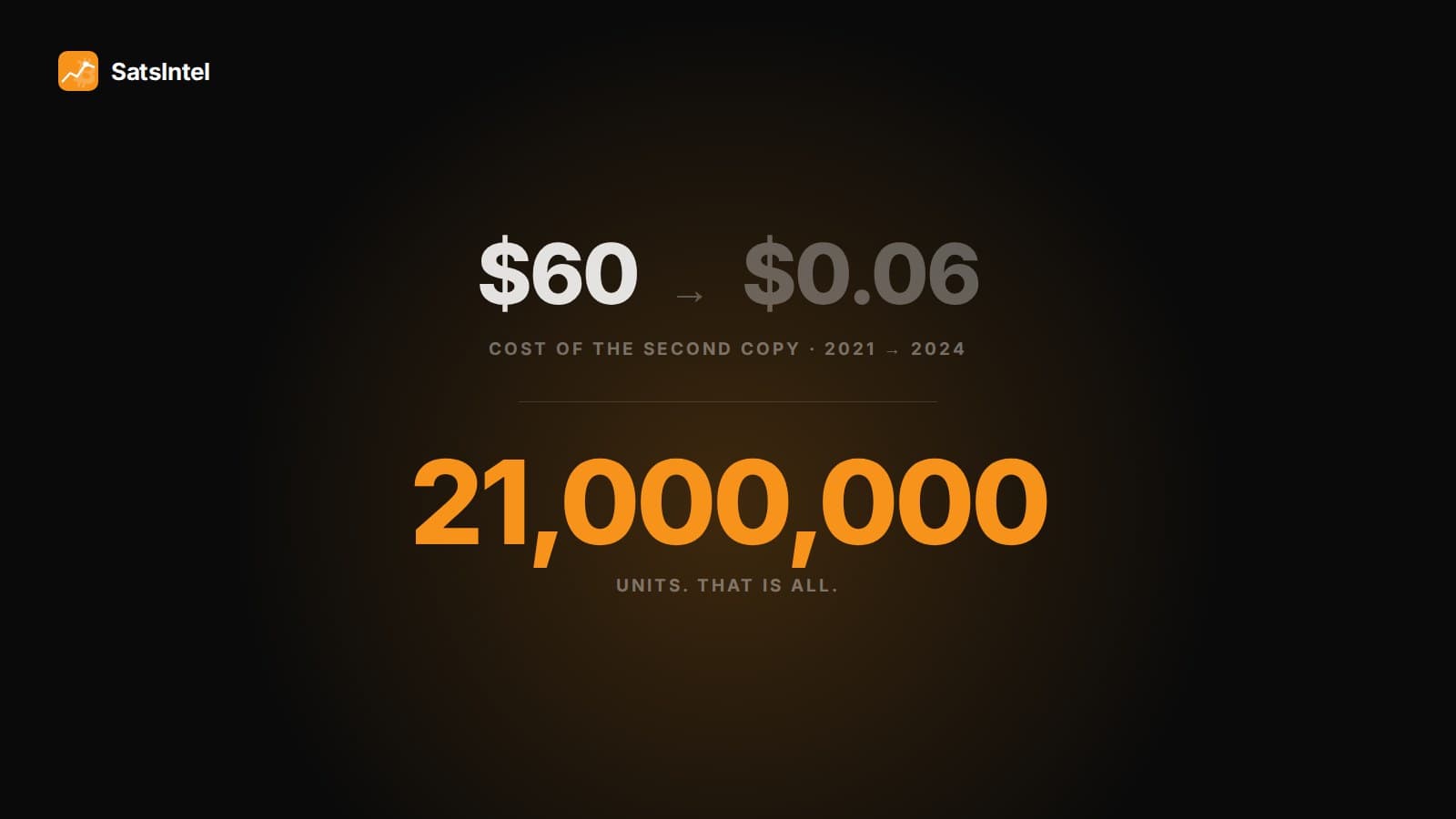
When GPT-3 became publicly available in November 2021, it was the only model able to score 42 on a general knowledge exam, and it cost sixty dollars per million tokens — roughly seven hundred thousand words. Three years later the same bar was being held by a small model served by an ordinary provider at six cents per million. A thousandfold in three years, around tenfold every year, according to the count a16z published at the end of 2024.
At higher capability levels the fall is slower, but it is still a fall. Epoch AI, which keeps the most careful books on this, calculates that holding GPT-4's level on PhD-grade science questions got about forty times cheaper per year. And they add the caveat that belongs there: the rate varies enormously depending on which threshold you measure, from nine to nine hundred times a year, and the steepest falls are the most recent ones, so nobody should assume this continues at the same pace.
It does not need to. At a fraction of that rate the conclusion is the same.
Because what is getting cheaper, seen from the necessary distance, is not intelligence. It is the act of making the second copy of something: the second analysis, the second report, the second piece of software, the second image. The first still costs whatever it costs to think it up. The second tends towards zero, and so do the third and the ten thousand after that.
For centuries, value and difficulty of reproduction were the same thing
That distinction is not a technical detail, because for centuries a good part of what we called value was, underneath, difficulty of reproduction. A portrait was worth something because painting it took weeks. A market report was worth something because gathering the data took months. A translator was worth something because translating was slow.
Since the two always travelled together — what was valuable was hard to copy, and what was hard to copy ended up valuable — we never had occasion to tell them apart. We had no reason to. Artificial intelligence is separating them in front of us, at a speed we are still digesting, and that is why value is migrating towards whatever does not admit that multiplication no matter how much intelligence you apply to it.
Few things are left in that category. One particular person's time. Land in one particular place. Trust, which still takes years to build and minutes to break. And a handful of assets whose total quantity is fixed in advance.
Twenty-one million, and a rule you can verify from home
Bitcoin has issued 20.08 million units out of a maximum of 21, a little over 95%, with an annual issuance of 0.82% that falls on its own over time, on a fixed schedule, without anyone having to decide it each morning.
That limit rests on a rule anyone can verify from their own home, and its entire guarantee rests on that verifiability. Not on a promise, nor on an institution's reputation, nor on anybody's good faith: on the fact that the count can be redone in full with an ordinary computer and a connection, and that if the result did not add up, we would know the same day. It is a considerably sturdier model than any alternative I can think of.
The 0.82% is worth pausing on, because it is the number most people skip. It is not a figure somebody picked this year: it is what remains of a schedule written more than fifteen years ago, which halves every four years and which two cuts from now will sit below 0.2%. ScarcityScarcityFixed maximum supply of 21 million Bitcoin, impossible to alter under the current protocol.View term → is not decided. It is executed.
The other number is decided in a meeting
Euro area M3 grew 2.7% year on year in April. It is a moderate and perfectly defensible figure, agreed by supposedly competent people in a meeting, and one that an equally competent meeting can revise next month.
You do not have to imagine it, because that is exactly what happened: 3.2% in March, 2.7% in April, 3.0% in May, 3.3% in June. Four months, four numbers. None of them is outrageous and all of them are reasonable. That is not the point. The whole difference lies in who retains the power to move and expand the number, and in the fact that this power, by definition, cannot be surrendered in advance.
Let me be clear about what I am not saying. I am not saying the people making those decisions do it badly, or in bad faith. I am saying that the difference between a rule and a decision does not depend on how good the decision is.
I am writing from Spain, and that shapes what I see
Where you stand shapes a great deal of what you see, and I am standing in a country where households hold a record 1.1 trillion euros in accounts and deposits.
Of that trillion-plus, around 937 billion sits in current accounts, which have spent a decade paying between 0.14% and 0.17%. Only about 161 billion sits in time deposits, which are the ones earning the roughly 1.6% the headlines talk about, and which has been drifting down. Meanwhile, July inflation came in at 3.6%.
Do the subtraction with whichever number applies to you. For the money on deposit it is two points of purchasing power a year. For the bulk of it, sitting in the current account, it is nearly three and a half. And all of it inside the most prudent decision a saver can make — the one their mother would recommend, the one that never appears in any headline about risk.
An entire generation grew up certain that saving and preserving value were the same operation. They will find out, late, that they had been conflating them for decades.
What this thesis is not
I say all this knowing that Bitcoin has fallen more than seventy per cent on three occasions in its history, that it will do so again, and that anyone who cannot stomach that volatilityVolatilityThe magnitude of the swings in Bitcoin's price over a given period.View term → is right to stay out. That is not a courtesy warning at the end of the piece: it is part of the thesis. An asset that appreciated without upheaval would never have been available at these prices.
None of the above attempts to predict the price. It is a thesis that will be built over the coming decades and that is judged by counting units, not by watching this week's quote. It is also, and this bears saying, the house thesis: SatsIntel exists to track the listed companies that have decided the same thing, and I am paid to think about this. Judge it accordingly.
In an age heading towards productive abundance, the only thing that keeps any value is whatever cannot be manufactured any faster. It really is that simple.