

How much of the Bitcoin that exists is in institutional hands? The answer, in 2026, surprises anyone who still thinks of Bitcoin as a purely retail asset: listed corporate treasuries, spot ETFs and sovereign states now hold around 2.5 million BTC, equal to more than 12% of circulating Bitcoin. It's a figure that keeps growing and has become one of the best thermometers of the asset's maturation. You can see the exact, updated number in SatsIntel's Bitcoin in institutional hands metric.
How much Bitcoin institutions hold
Institutional Bitcoin exposure splits into several blocks, which SatsIntel tracks and categorizes from its editorial directory:
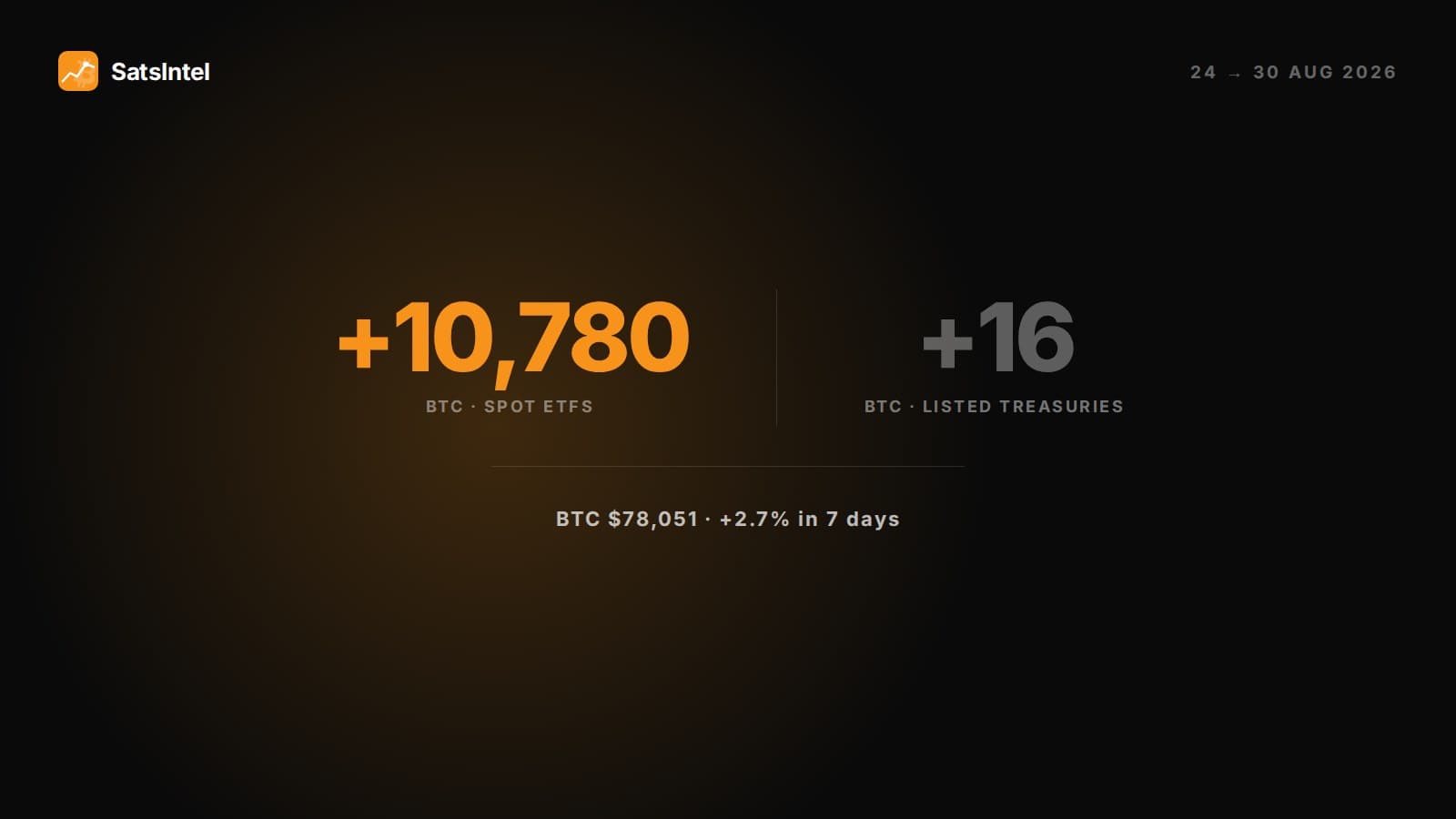
The US spot ETFs, approved in January 2024, hold one of the largest pools of institutional Bitcoin. They custody the asset on behalf of institutional and retail investors who prefer regulated exposure to self-custodySelf-CustodyDirect control of Bitcoin private keys without relying on a third party.View term →. It's the fastest-growing category. Explore it in the spot ETF explorer.
The pure corporate treasuries —companies holding Bitcoin as their primary reserve asset, led by Strategy (formerly MicroStrategy)— are the other big block. Unlike an ETF, they are operating companies that use financial engineering to accumulate Bitcoin per share. The treasuries directory tracks them all.
The rest is split between miners holding Bitcoin on their balance sheets (rather than selling what they mine), funds and exchanges with their own BTC, sovereign states —El Salvador, which bought it and made it legal tender, and Bhutan, which mined it with hydroelectric power— and other entities. The full breakdown, with each category's share, is on the metric page.
What it's measured against: circulating supply vs 21 million
There are two ways to express this percentage, and they shouldn't be confused. Bitcoin has a fixed max supply of 21 million units, but not all have been issued: around 19.9 million are in circulation (the rest will be mined until roughly the year 2140, in ever-smaller amounts after each halvingHalvingThe halving of the mining reward every 210,000 blocks (~4 years).View term →).
Measuring institutional exposure against circulating supply shows what share of the Bitcoin that exists TODAY is in institutional hands —a higher, more representative figure of the real available float—. Measuring it against the 21 million gives a somewhat lower number, useful for long-term thinking. SatsIntel shows both references; the gap between them is small, but it matters for interpreting the figure rigorously.
Why this figure matters
That more than 12% of circulating Bitcoin is in institutional hands marks a structural shift from the asset's early years, when almost all of the supply sat in retail wallets. The reason this metric is so closely watched isn't just the volume, but the type of hands: a listed treasury, an ETF or a sovereign reserve tends to buy Bitcoin to hold long term, not to trade short term. Every Bitcoin that enters one of these vehicles tends to leave the float available for daily trading.
That gradual reduction of the liquid float, combined with new supply halving every four years, is one of the central arguments of Bitcoin's store-of-value thesis: growing institutional demand against an increasingly rigid supply. That's why tracking the evolution of this percentage —not just its level— is so telling: its upward trend is the footprint of institutional adoption.
How to follow the figure live
SatsIntel publishes this metric continuously on its Bitcoin in institutional hands page, with the exact percentage of circulating supply, the category breakdown and a chart of its evolution. It's a proprietary, differentiated figure: it can only be computed by crossing a categorized treasuries directory with Bitcoin's supply. It is part of SatsIntel's institutional Bitcoin indicators, alongside Bitcoin in treasuries, in ETFs and aggregate exposure.
In short
In 2026, more than 12% of circulating Bitcoin —around 2.5 million BTC— is in the hands of listed treasuries, spot ETFs and sovereign states. Most of it sits in ETFs and pure corporate treasuries, and the figure keeps growing. It's one of the clearest signs that Bitcoin has moved from being a retail asset to becoming, structurally, part of institutional balance sheets. Follow the exact figure and its evolution in SatsIntel's live metric.