
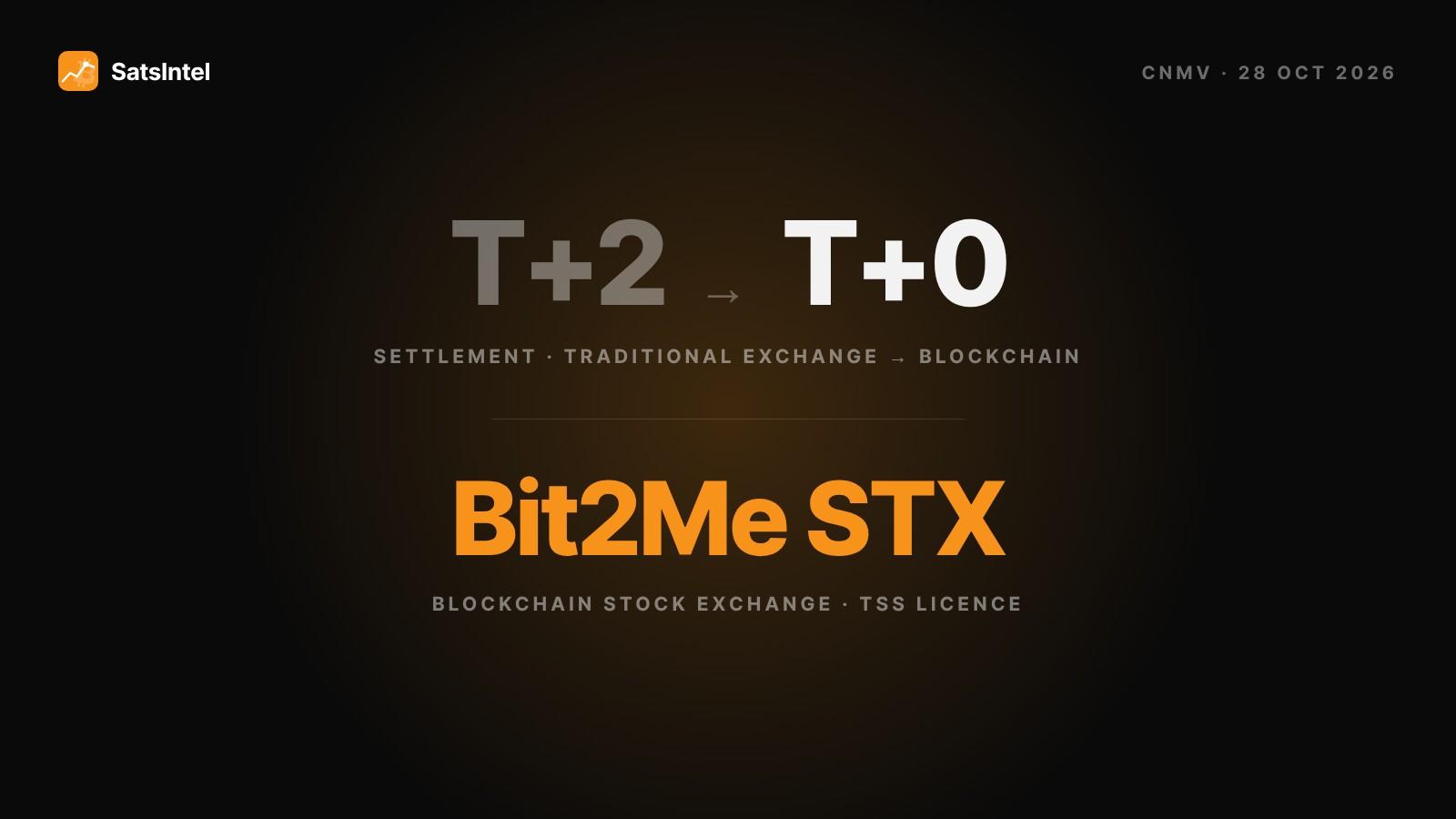
On 28 October Spain's securities regulator, the CNMV, authorised Bit2Me STX, a subsidiary of the Bit2Me group, to operate a Trading and Settlement System (TSS) under the European Union's DLT Pilot Regime. With that licence STX can open a stock exchange where shares, bonds and funds are issued, traded, held in custody and settled directly on a blockchain.
Its CEO and co-founder, Javier Tordable, sat down with us on episode 29 of Show Me The Bitcoin (in Spanish) a few weeks before the authorisation arrived. This article brings the two together: what the official documents say about the licence and what he told us about how the exchange will run.
One disclosure first. Show Me The Bitcoin is the podcast of Standard 21, the company that publishes SatsIntel, and in the interview we asked him about Standard 21's own stock market listing. We cover that further down.
What the CNMV has authorised
The TSS licence is the category created by Regulation (EU) 2022/858, known as the DLT Pilot Regime, for market infrastructures that trade and settle on the same platform using distributed ledger technology. Together with the investment firm licence STX already held, it allows the company, according to Bit2Me's press release, to:
- Run a primary and a secondary market in security tokens, which are ordinary financial instruments (shares, corporate bonds and funds) issued natively on blockchain. - Act as ERIR, the entity responsible for registering the issues, a role that Iberclear plays in Spain's traditional market. - Hold those securities in custody and distribute them on behalf of third parties.
The market will run 24 hours a day, 7 days a week. Smart contracts do the clearing house's job and settlement is instant (T+0), delivery versus payment. A custodian bank tokenises euro deposits to connect the platform to the financial system.
Three and a half years
The technology was the quick part. "We built it in eight months," Tordable told us. The rest of the time went on licences:
1. March 2023. Spain's new Securities Markets Law allows securities to be represented with distributed ledger technology. STX is incorporated that year. 2. November 2024 to February 2025. In the financial sandbox run by the CNMV and the Treasury, STX issues, trades and redeems the Valorix Token 4T24 (ISIN ES0305845002), a three-month corporate bond of 145,000 euros whose coupon was paid on blockchain. 3. November 2025. The CNMV authorises STX as an investment firm. 4. October 2026. The TSS licence arrives.
Along the way the parent company obtained its MiCA licence in July 2025, the first granted in Spain to a company that is not a bank, and a payments licence in June 2026. The group's shareholders include Telefónica, Unicaja, Investcorp, BBVA, Cecabank, Bankinter, Inveready and Tether.
Who Javier Tordable is
He has spent almost thirty years building exchanges. He learned the trade at Deutsche Börse, brought Eurex's derivatives platforms to Spain in 1999, and his first market licence was MTS Spain, for government bonds, in 2004.
In 2017, with Bitcoin above 16,000 dollars and institutions asking for hedging instruments, he was part of the Eurex group that decided not to launch Bitcoin derivatives. He tells the story himself on the podcast, and sums it up with the words they used at the time: "a fraudulent instrument, drug traffickers, there's nothing behind it". Eurex lists them today.
When MiFID opened up European trading in 2007 he set up PAVE, an alternative Spanish trading platform. It obtained every licence, but only three of the twenty brokers operating in Spain backed it, and he lost more than half of his personal wealth in the attempt. According to him, the alternative platforms that came from abroad now trade more Spanish shares than the Spanish exchange itself.
He met Bit2Me's founders in 2021 through Inveready, a shareholder in both projects. They teamed up in 2023, once Spanish law and the European pilot regime gave the idea legal certainty. His conversion to Bitcoin came later, in October 2023, when his partners told him the US spot ETFs would be approved in January. "I pictured the river, the dam, and opening it."
Who it is for
STX calls itself the stock exchange for private markets. It targets tech, growth, pharma and renewables companies that today raise money through venture capital, private equity, direct lending or private debt, and for which BME Growth or Spain's fixed income market MARF are too big or too expensive.
The main argument is cost. According to Tordable, in a small listing the infrastructure takes 15% to 20% of the money raised, on top of around 350,000 euros to list and around 15,000 euros a month to stay listed. His aim is to cut that by up to 90%. The reasons he gives are an in-house, open-source blockchain and a team that will not exceed ten people, supported by the group's services. "In other exchanges, 60% of revenue went on technology."
The pilot regime sets limits. It only covers shares, bonds and UCITS funds, with no derivatives or ETFs. Share issues cannot exceed 500 million euros, bond issues 1,000 million, and the issuer's market capitalisation 9,000 million. He told Expansión he expects that ceiling to go in a year to a year and a half, and that he does not expect IBEX companies to come to STX, though some of their subsidiaries might. Early issues will be between 1 and 10 million euros, and on the podcast he stressed the filter: "This isn't for PowerPoint startups."
Only public limited companies (sociedades anónimas) can list. A share in a Spanish limited liability company (SL) carries a pre-emption right that forces the seller to ask every partner before each sale, which makes secondary market trading impossible.
How a company lists on STX
According to what Tordable told Expansión, the process has four steps:
1. Bit2Me's compliance committee and STX's risk committee review the project. 2. The deal is structured in an issue document. Above 12 million euros a full prospectus is required, equivalent to a BME listing; below that, a shorter document also approved by the CNMV is enough. 3. The listing is a capital increase registered on the STX blockchain. 4. After subscription, the security starts trading with its ISIN code and its Digital Token Identifier (DTI).
Investors become direct members of the market, with no bank or broker in between. To join they must pass Bit2Me's compliance checks and knowledge questionnaires agreed with the CNMV. Signing up and watching the market costs nothing.
Eleven projects and a first issue
STX has eleven projects in talks. To Expansión it gave the split in thirds: growth companies, venture capital funds and money market funds, with two of them already listed on BME. On the podcast he singled out three: a tech company, a robotics company and a venture capital fund that would be the first to trade on a secondary market. "This is historic."
The first issue, according to Bit2Me's release, will come from Valorix, the same issuer as in the sandbox: a tokenised bond of 1 million euros for eligible investors, planned for December 2026, which will then trade on the secondary market. Shares, bonds and funds will follow in 2027, subject to approval by the admissions committee.
Liquidity, the hard part
Tordable keeps coming back to one idea throughout the interview: technology enables it, but an exchange lives on liquidity, both primary and secondary. To get it he describes five layers:
1. The Bit2Me group's customers: 1.2 million people and 4,000 companies and family offices already familiar with the technology. 2. The group's shareholders, banks and Tether, which can act as registered advisers or liquidity providers. 3. A board of directors made up of people who have run exchanges. 4. Market makers, from traditional finance and from crypto. 5. The issuers themselves, the bigger the community they bring, the better.
He also warns that a small company will not trade like Telefónica. For him, a previously unlisted company getting a public price already adds value, even on days with no trades. In the sandbox there was one transaction a day.
Its own permissioned blockchain
STX runs on 2Chain, a group network built on Hyperledger Besu and compatible with Ethereum. They chose their own network to avoid depending on gas fees on a public chain, which are volatile and outside their control. It is a permissioned network using proof of authority: the nodes are invited entities, up to twenty, and STX decides who validates. "Public, but permissioned. So it's private," Tordable jokes; he explains the architecture to regulators with Star Wars analogies.
The platform complies with DORA, the EU's digital operational resilience regulation, and has contingency plans approved by the CNMV: if its blockchain failed, it could temporarily move issues to traditional book entries or reissue them on another network. It can also issue on other chains. If an issuer wants to issue on Ethereum, STX accepts it.
Tokenisation versus "croquetisation"
Part of the interview is about separating what STX does from other products sold as tokenised shares. Tordable sets two conditions for a token to be worth anything: it must replicate the economic flows of the asset and it must be enforceable before a judge. STX's shares are shares with all their rights, including voting at the general meeting. Being on a blockchain makes them more efficient; legally they are shares.
The rest he calls "croquetisation", after the Spanish croqueta: tokens representing stakes in vehicles that in turn hold shares in an unlisted company, such as the OpenAI tokens offered through a Luxembourg company. He admits there are "good croquetas", but points out that the CNMV distinguishes between a financial instrument and a transferable security, and that those products cannot trade on an organised market with a central limit order book.
Where should a treasury company like Standard 21 list?
We asked him directly, because Standard 21 plans to go public next year. His answer was that listing is a means, and that the choice depends on who you want to reach. To raise money from institutional funds in the short term, he said, BME offers more certainty because more participants are connected to it. STX reaches an audience that is more familiar with crypto. He also pointed out that in Spain a company cannot run a continuous at-the-market share sale (an ATM) like the ones Strategy uses, and that for now STX can only host plain bonds, shares and UCITS funds.
Listen to the full interview
The episode page has the video, the chapters and the full transcript, in Spanish. There is more on PAVE, on how he negotiated with regulators, and on what he would say to a 60-year-old who has never looked at Bitcoin: "Study, analyse and invest."
If you are interested in the tokenisation of financial assets, we also wrote about how Strategy's STRC preferred stock reached the blockchain.
SatsIntel is an information service and does not provide financial, tax or legal advice. Investing in tokenised financial instruments carries risks, including losing all or part of the capital and not finding a buyer on the secondary market. Bit2Me STX data checked on 12 November 2026 against the company's press release and Expansión's reporting of 28 and 29 October.

