STRKSTRFPreferredsFixed incomeStrategy

Strategy's perpetual preferreds: fixed income with indirect Bitcoin exposure

·8 min read·
🇪🇸 Leer este artículo en español →
Financial documents and investment charts
Key points
  • 01Strategy's preferreds pay between 8% and 12% in fixed annual dividends.
  • 02They are perpetual instruments with no maturity, but the issuer can redeem them early.
  • 03The main risk is not Bitcoin's volatility but Strategy's solvency as issuer.

Build your Bitcoin investment portfolio

Create your free portfolio and track your Bitcoin exposure —treasuries, ETFs and direct BTC— in one place, with weighted mNAV and BTC Yield.

Create my portfolio →

When Strategy issued its first perpetual preferred in January 2025 — STRK, with an 8% dividend — it opened an entirely new market: fixed-income instruments with indirect exposure to the largest Bitcoin balance sheet in the world.

The logic for the investor is simple. Buying Strategy stock (MSTR) means taking on all of Bitcoin's volatility amplified by the company's leverage. Buying a Strategy perpetual preferred means receiving a fixed, predictable dividend, while the risk is bounded to the company's ability to keep paying that dividend.

Preferreds are neither stocks nor bonds in the traditional sense. They have features of both: like bonds, they pay a fixed coupon. Like preferred equity, they are perpetual (no mandatory maturity) and subordinate to debt but above common shareholders in a liquidation.

Today, Strategy has four active issues. STRK at 8% quarterly, the first and most liquid. STRF at 10%, launched in March 2025 for investors seeking higher yield. STRC at 12% with two payments a month (monthly until June 2026), designed to enable continuous ATM offerings. And STRD at 10%, the most recent. You can track all of them in the preferreds hub.

The par value of each is $1,000 per preferred share, implying annual payments of $80 to $115 per share depending on the instrument. STRC's monthly payment ($9.58 a month) makes it the most interesting instrument for investors seeking regular cash flow.

What is the real risk? Not that Bitcoin falls. STRK's dividend is not tied to the price of Bitcoin: Strategy pays it with the capital it raises from new issuance. The risk is that Strategy can no longer issue new capital (because the market closes, investors lose confidence, or regulatory conditions change) and then cannot keep up the payments.

In that extreme scenario, preferred holders would have priority over common shareholders in a liquidation. With 848,517 BTC on the balance sheet, coverage is substantial even at prices well below current levels. Our stress test models exactly that.

For the investor who believes in Bitcoin but doesn't want to sleep with MSTR's volatility, Strategy's preferreds are an elegant solution. It is not Bitcoin. It is not traditional fixed income. It is something new: debt backed by the largest accumulation of digital scarcity in the world.

Found this useful? Share it:
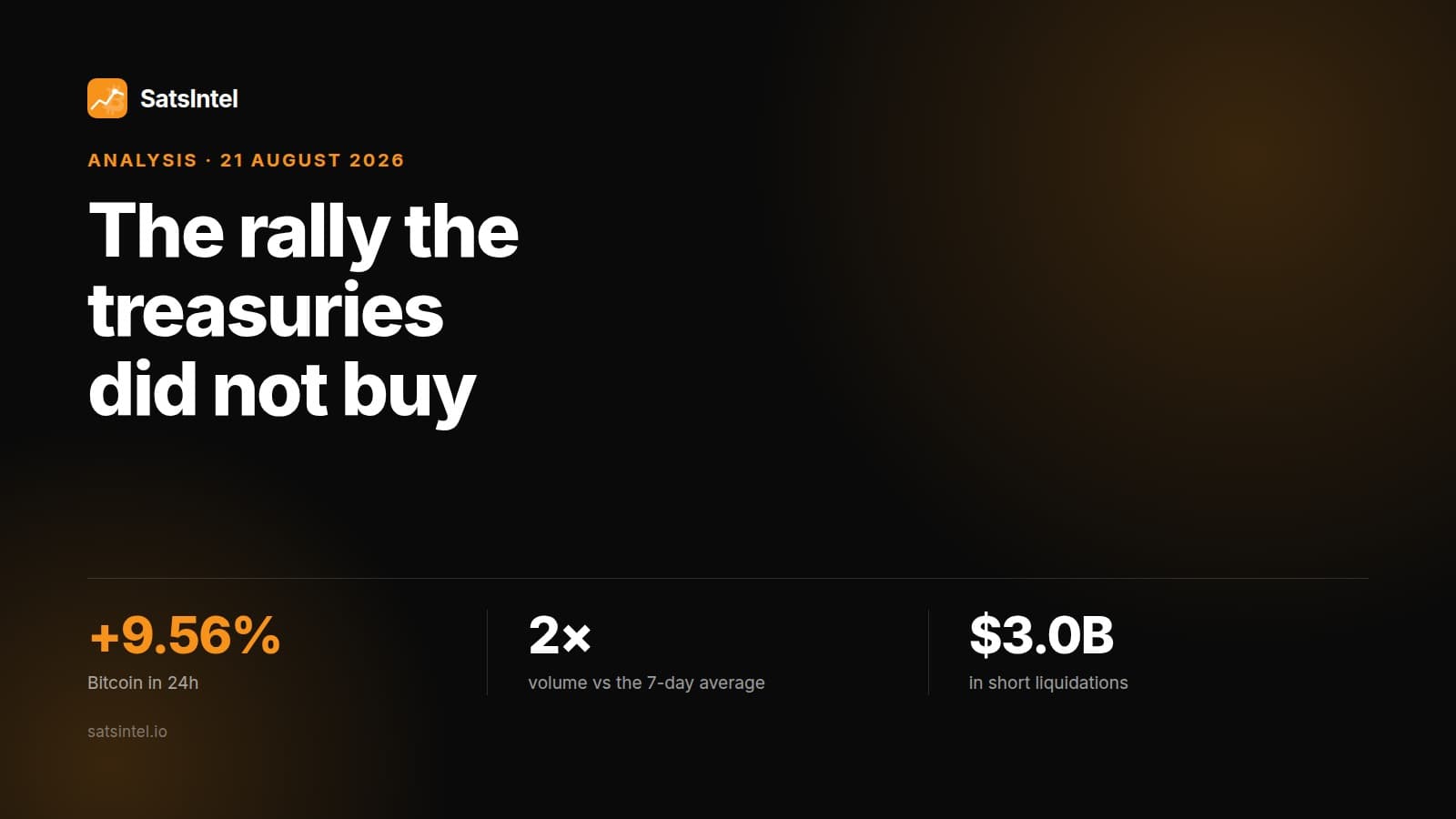
Cover of the post on the Bitcoin rally of 21 August 2026, with the three key figures: a 9.56% 24-hour gain, double the trading volume and $3 billion in short liquidations
AnalysisTreasuries

The rally the treasuries did not buy

→ $63.7 billion in 24-hour volume, 101.9% above the average of the previous seven days.

Aug 21, 20268 min
Financial analysis charts illustrating Strategy's balance sheet strategy and its Bitcoin sales
StrategyPreferreds

Why Strategy is selling Bitcoin: the three sales of 2026 and what is driving them

→ Strategy has sold 5,258 BTC in 2026 across three transactions —32, 3,588 and 1,638 BTC— and still holds 848,517: what it has sold is 0.6% of the position.

Aug 5, 20269 min
Conceptual scale weighing a treasury company's dollar obligations against the Bitcoin on its balance sheet
StrategyTreasuries

Can a Bitcoin treasury company be forced to sell? Strategy's 2026 pivot

→ A Bitcoin treasury company with no secured debt cannot receive a margin call on its BTC: the real risk isn't collateral, it's the dollar cash needed to pay preferred dividends and interest.

Jul 28, 202614 min
Candlestick chart of a financial market on a screen
STRCSATA

STRC vs SATA: which Bitcoin preferred pays more — and which held up better? (August 2026)

→ SATA pays 13% a year in ~250 daily installments (compounded effective yield ~13.9%) and trades near par; STRC pays 12% semi-monthly and closed July at $89.46, 10% below its $100 par.

Jul 15, 202612 min
Banknotes and coins stacked on a work desk
PreferredsDigital Credit

Bitcoin preferred stocks: what they are, how they work and who issues them (2026 guide)

→ A Bitcoin preferred is a perpetual security paying a fixed or variable dividend on a par value (typically $100), issued by a company whose solvency rests on its Bitcoin treasury and its access to capital markets.

Jul 14, 202610 min
Gold bitcoins representing MicroStrategy's Bitcoin balance sheet.
MicroStrategyStrategy

MicroStrategy's balance-sheet strategy: Strategy's financial engineering explained

→ Strategy's model is not 'buy and hold': it is raising capital in public markets (convertible debt, ATM offerings, preferreds) and deploying it into Bitcoin continuously.

Jun 9, 202610 min
Financial performance chart illustrating dividend income with Bitcoin exposure.
Fixed incomeDividends

Bitcoin dividends: how to generate income with BTC exposure (2026)

→ Bitcoin pays no dividends: it has no cash flow and cannot be staked (it uses proof of work). Any product promising 'yield for staking Bitcoin' is a loan with counterparty risk or outright fraud.

Jun 4, 202610 min
Physical Bitcoin coin on a computer motherboard with illuminated circuits
STRCDigital Credit

STRC and the rise of Digital Credit: Strategy's monthly preferred comes to the blockchain

→ STRC raised $2,521M in its July 2025 IPO: the largest perpetual preferred offering in the US since 2009 and the largest US IPO of the year.

May 7, 202612 min

Did you find this analysis useful?

Get a weekly editorial digest of what matters most in corporate Bitcoin. The issues are written in Spanish.