

"Can you earn dividends in Bitcoin?" It is one of the most common questions among investors arriving in crypto from traditional equities, used to collecting a quarterly dividend on their shares. The short answer is nuanced: Bitcoin itself pays no dividends. But there is an institutional, regulated and increasingly popular way to generate income with Bitcoin exposure: the preferred shares and fixed income issued by Bitcoin treasury companies. This guide explains what's real, what's smoke, and how to access that income stream.
Does Bitcoin pay dividends?
No. And it is worth understanding why, because it is the basis for avoiding scams. A dividend is the distribution of a company's profits among its shareholders. Bitcoin is not a company: it is a scarce digital asset, with no cash flow, no board and no profits to distribute. Nor can it be "staked" like Ethereum or other proof-of-stake networks — Bitcoin uses proof of workProof of WorkBitcoin's consensus mechanism: miners compete to solve complex mathematical problems.View term → (mining), not staking — so any product promising a "yield for staking Bitcoin" is, at best, a disguised loan with counterparty risk and, at worst, a fraud.
That said, you can build an income stream around Bitcoin. The serious route is not "Bitcoin paying you," but listed instruments issued by companies that hold Bitcoin on their balance sheet and pay a fixed dividend in exchange for your capital.
The institutional route: treasury preferreds
Bitcoin treasury companies — listed firms whose main reserve is BTC, such as Strategy or Strive — finance their Bitcoin purchases by issuing, among other instruments, perpetual preferredPerpetual PreferredFixed-income instrument with no maturity that pays a fixed dividend, ranking ahead of common shareholders.View term → shares. For the investor, these preferreds work like fixed income: they pay a fixed periodic dividend (usually in cash) and have payment priority over common stock.
It is the closest thing to "earning a Bitcoin-backed dividend" that exists today in regulated form. You don't get paid in BTC, but you collect a stable coupon from a company whose thesis is Bitcoin. You can see them all with live data in the Bitcoin fixed-income hub.
How much they pay: the available preferreds
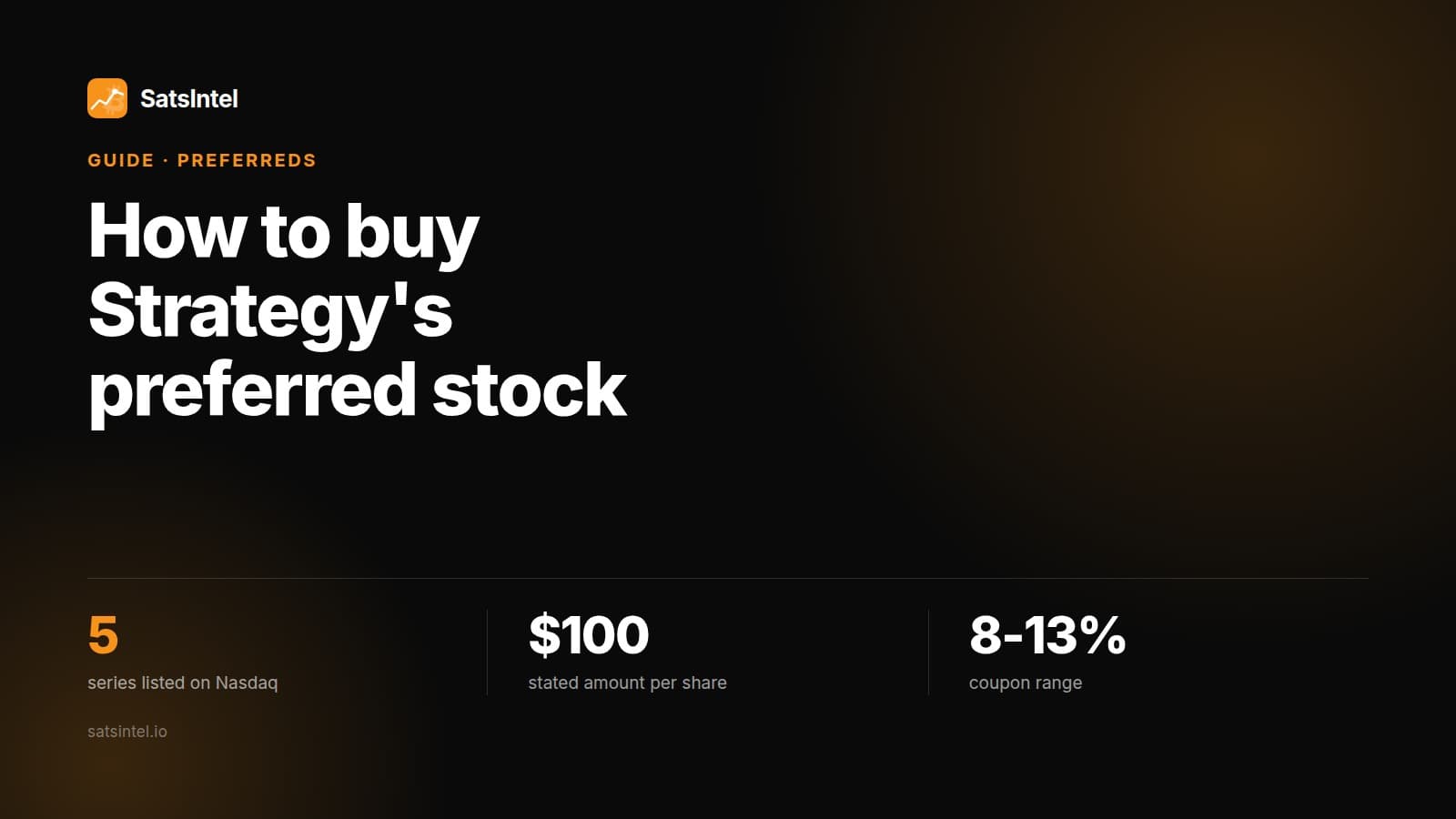
Today, the main perpetual preferreds of Bitcoin treasuries are these. Strategy has four series, all on a $100 par value: STRK pays 8% annually, quarterly; STRF, 10% quarterly; STRD, another 10% quarterly; and STRC, 12% annually with two payments a month (on the 15th and last day, since June 2026) — the one most oriented to investors who want frequent income. Strive, Vivek Ramaswamy's manager, issues SATA, a variable-rate perpetual preferred with a 13% reference yield, paid every business day since June 2026 — the market's first daily-pay preferred.
The real effective yield you'll get depends on the price you pay versus that $100 par: if the preferred trades below 100, your yield on cost is higher than the nominal coupon; if above, lower. That is why at SatsIntel we show the live price and effective yield of each one.
Direct yield on Bitcoin: what treasuries do
There is a second layer of "yield on Bitcoin," but it does not reach the retail investor as a dividend: it is the yield the treasuries themselves extract from their BTC, deploying it as collateral in institutional products. That return accrues as more Bitcoin on the balance sheet — raising BTC per share without diluting the shareholder — rather than being distributed. We develop it in the guide to perpetual preferreds and Bitcoin fixed income.
How NOT to earn Bitcoin dividends: scams to avoid
Interest in "Bitcoin dividends" has spawned an ecosystem of fraudulent products. Warning signs: promises of fixed, high, risk-free yield — "1-3% daily," "Bitcoin staking," "guaranteed cloud mining." Bitcoin generates no yield by itself, so that payout comes from new entrants' capital: the pattern of a Ponzi scheme. And unregulated platforms that custody your BTC and promise to pay you interest. Although some are legitimate (lending), counterparty risk is real and has already wiped out several (Celsius, BlockFi). "Not your keys, not your coins" applies here too.
The difference with preferreds is one of nature: a Strategy or Strive preferred trades on a regulated market (NASDAQ), has an SEC-registered prospectus, and the dividend is a contractual obligation of an audited company. That is not the same as the yield promise of an unlicensed app.
Summary
Bitcoin pays no dividends — and you should distrust anyone who says otherwise. But if what you want is income with exposure to the Bitcoin thesis, the perpetual preferred shares of treasuries (STRK, STRF, STRC, STRD, SATA) are the institutional, regulated and transparent route: a fixed dividend backed by companies whose reserve is Bitcoin. Start with the Bitcoin fixed-income hub.
This article is education, not financial advice. Preferred shares carry risks — issuer credit, interest rate, liquidity and market — and are not equivalent to a guaranteed deposit. Do your own due diligence before investing.