

For years, "institutional Bitcoin adoption" was a promise repeated each cycle. In 2026 it has stopped being one: it's a measurable reality, built on regulated infrastructure and at a scale that already moves the market. Institutional capital enters Bitcoin today through three distinct channels that reinforce each other. This article walks through them and puts the current correction in context.
Three lanes for institutional capital
Bitcoin's institutionalisation isn't a single phenomenon but three at once: the spot ETFs (Wall Street buying regulated passive exposure), the corporate treasuries (listed companies putting Bitcoin on their balance sheet) and the states (sovereign entities adopting it as a reserve). Each lane has its own logic, risk profile and type of buyer, and together they explain why adoption this time is structural rather than speculative.
The ETFs: Wall Street's door
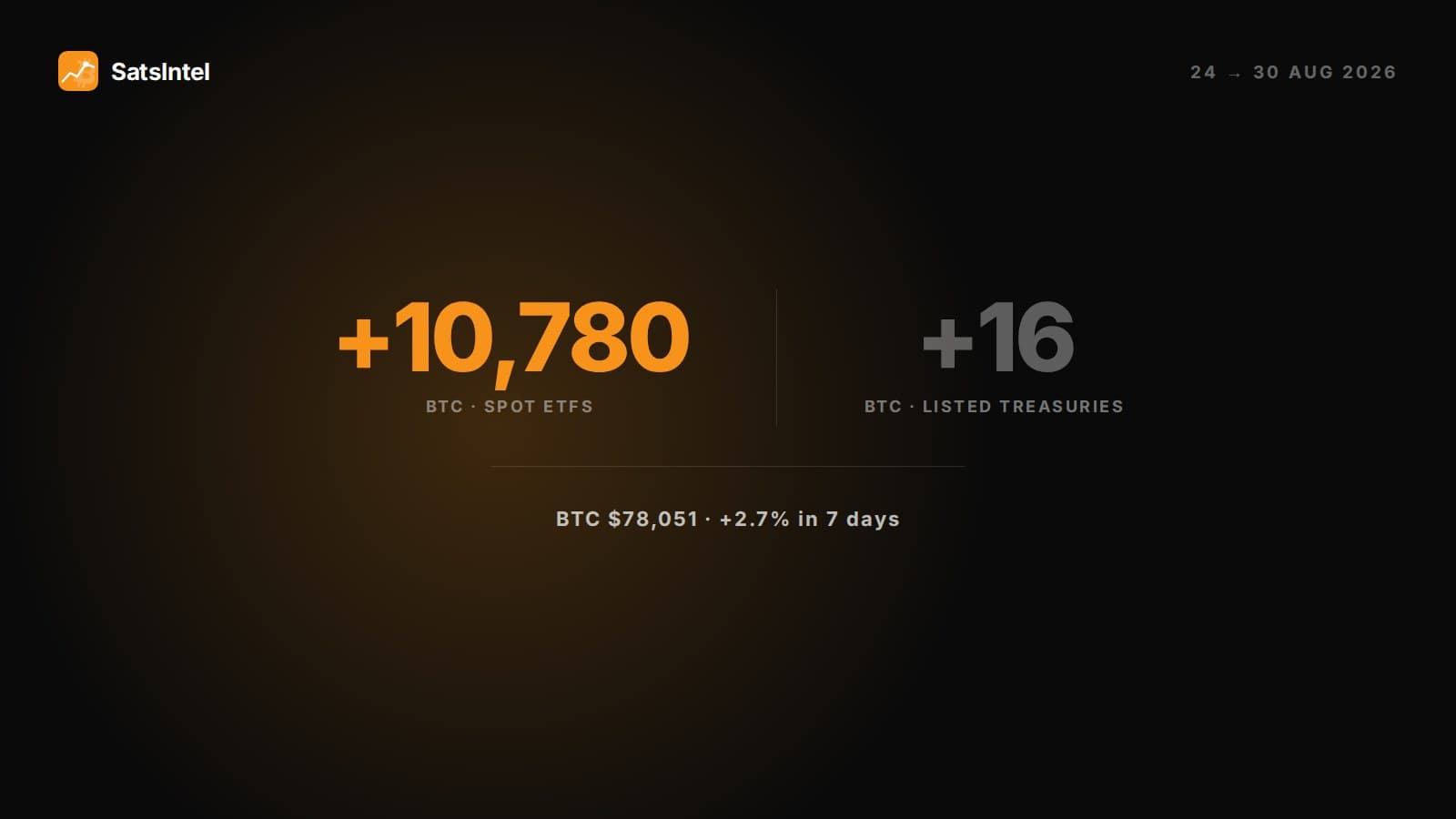
The US spot ETFs, approved in January 2024, were the most successful product launch in the history of exchange-traded funds. They hold more than $105 billion in assets and have surpassed $50 billion in net inflows since their debut, tripling the launch's most optimistic forecasts. But the most relevant point is not the size, but who's inside: SEC filings show Goldman Sachs, Morgan Stanley and dozens of hedge funds among the holders, and several Middle Eastern and Asian sovereign funds have disclosed exposure. The ETF turned Bitcoin into one more line of institutional asset allocation. You can track the flows and size of each in the spot ETF comparison.
The treasuries: Bitcoin on the corporate balance sheet
The second lane is the one we know best at SatsIntel. Today 179 listed companies already hold Bitcoin in their treasury, with an aggregate of 1,288,519 BTC — 6.14% of the 21 million maximum supply. And the pace matters: institutions, led by treasuries and ETFs, have been buying at a multiple of newly mined supply, structurally tightening the asset's availability.
Strategy (formerly MicroStrategy) remains the largest with 845,050 BTC, but the novelty of 2026 is the globalisation of the model: Metaplanet has taken it to Asia from the Tokyo Stock Exchange, and Latin America has entered strongly with vehicles like OranjeBTC and Méliuz, which we cover in the Latin American treasuries map. The complete list of Bitcoin treasuries captures the global picture. What sets this lane apart from the ETF is that the treasury doesn't just replicate the price: it amplifies it via the market premium (mNAV) and the growth of Bitcoin per share.
The states: the sovereign frontier
The third lane is the most nascent but the one with the greatest long-term implication: sovereign adoption. El Salvador opened the path and keeps a treasury of around 7,667 BTC, buying systematically and framing it as a strategic state reserve. Beyond the pioneer case, the presence of sovereign funds among ETF holders indicates that state and quasi-state interest is no longer anecdotal. When a state treats Bitcoin as a reserve, it changes the nature of demand: it's the buyer with the longest horizon and the least sensitivity to short-term price.
The maturity test: the current correction
As we write, the market is going through a correction — Bitcoin is down double digits over the last month, far from its all-time highATHAll-Time High: the highest price an asset has ever reached.View term →, and the spot ETFs closed May with their largest monthly outflow of the year. Far from contradicting the institutional thesis, this confirms it: mature markets have drawdowns too. The difference is how each type of capital behaves. Speculative flow exits; the structural accumulator — the disciplined treasury, the state, the long-term allocator — takes advantage. VolatilityVolatilityThe magnitude of the swings in Bitcoin's price over a given period.View term → is the toll, not the risk.
What it means for the investor
The three lanes are built and open. For the investor who wants to participate, the tools exist depending on the objective: passive exposure via ETFs or their European equivalents; amplified exposure via listed treasuries; and income via the preferred shares of those same treasuries. Institutionalisation is not something that's going to happen: it's happening, at scale, and what's changed is that the retail investor can now sit in the same vehicles as the institutions.
This article is education and analysis, not financial advice. Investing in Bitcoin and related products carries the risk of loss.